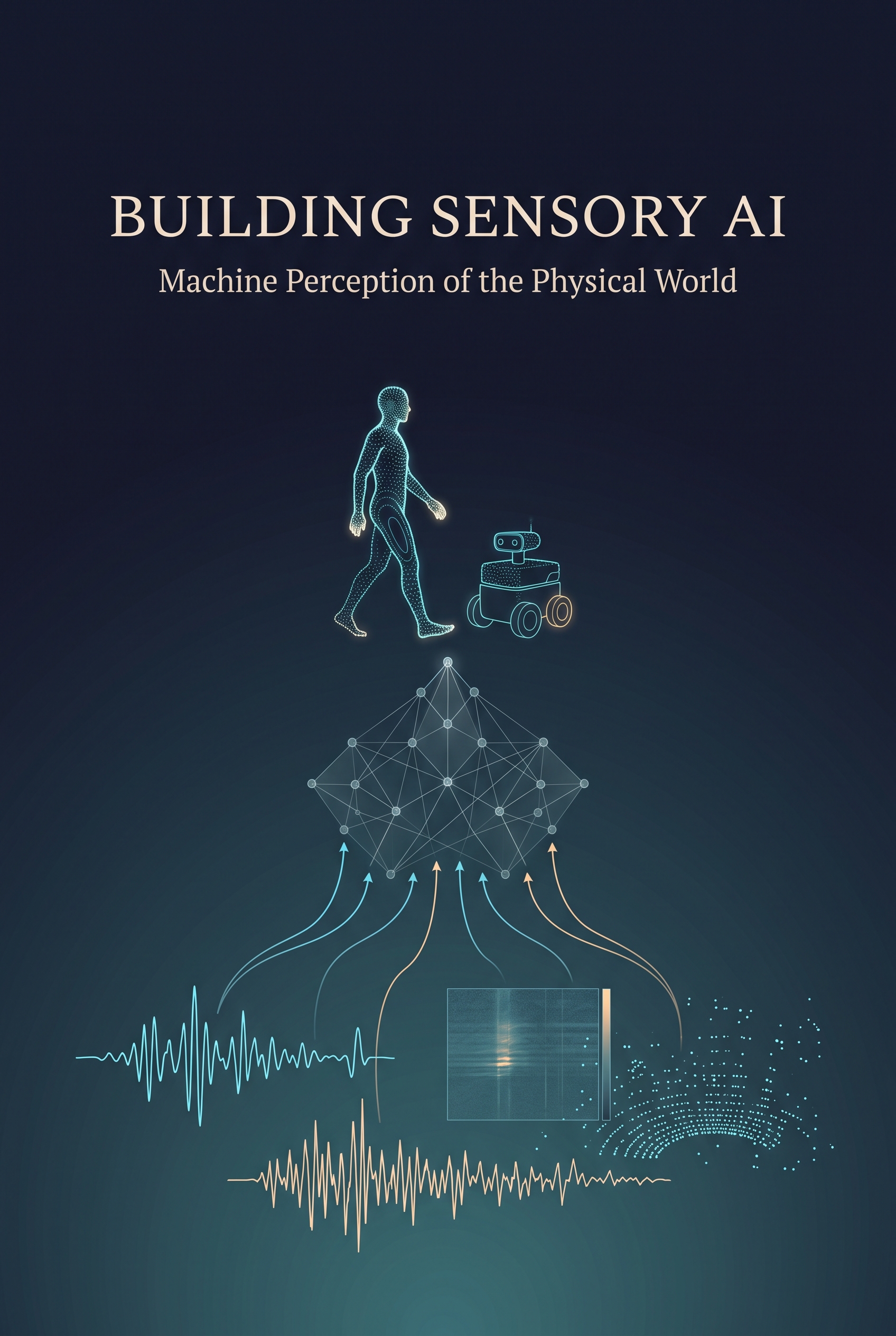
Building Sensory AI Machine Perception of the Physical World
A practitioner's guide to the full sensing chain: signal processing, state estimation, deep learning and foundation models for sensor data, multimodal fusion, and trustworthy deployment.
Most AI meets the world through text and pictures. Sensory AI starts earlier, at the device that measures reality imperfectly. This book is one connected journey through the theories, models, and engineering practices for systems that perceive the physical world through inertial, vibration, radar, lidar, depth, thermal, event, RF, tactile, and biomedical sensing. It begins with sensor physics and measurement models, builds through classical filtering and state estimation into deep learning and sensor foundation models, then moves into fusion, world models, and edge deployment, before closing with the evaluation, robustness, safety, and responsible-practice concerns that govern real systems.
The Fourteen-Part Arc
Six verbs carry the book: measure, clean, represent, infer, fuse, deploy. Each part stands on the one before it.
Foundations of Sensory AI
Establish sensory AI as inference from noisy measurements, and equip every reader with the shared mathematical and engineering vocabulary.
5 chapters · 36 sections IIClassical Signal Processing and Feature Engineering
Build durable foundations that still power, and often beat, deep models on real sensor systems.
3 chapters · 21 sections IIIState Estimation and Classical Inference
The probabilistic backbone of sensing that fusion, tracking, and safety all build on.
4 chapters · 28 sections IVDeep Learning for Sensor Time Series
Move from features to neural representation learning for multivariate sensor streams.
6 chapters · 42 sections VFoundation Models and Agentic Sensing
Teach the pretrain-once, adapt-anywhere paradigm that reshaped sensor and time-series AI in 2023-2026, and the language-interfaced, agentic layer on top of it.
4 chapters · 28 sections VIMotion, Location, and Inertial Intelligence
IMU, GNSS, RF positioning, motion estimation, activity, and neuromotor interfaces.
5 chapters · 35 sections VIIHealth, Biosignals, and Wearable AI
Sensory AI for physiological data under strict reliability, validation, and ethics constraints.
7 chapters · 49 sections VIIIIndustrial, Energy, and Infrastructure Sensor AI
Predictive maintenance, condition monitoring, and cyber-physical anomaly detection at industrial scale.
5 chapters · 35 sections IXRadar, Lidar, Depth, Thermal, Event, and RF Sensing
Active and non-RGB sensing for autonomy, robotics, security, health, and industrial perception.
8 chapters · 56 sections XSensor Fusion, World Models, and Spatial AI
Combine measurements into coherent state estimates and predictive world representations.
8 chapters · 56 sections XITactile, Embodied, and Robotic Sensing
The sensing that makes robots and embodied agents perceive and act.
3 chapters · 21 sections XIIEdge, Embedded, Streaming, and Federated Sensor AI
Run sensory AI where the data is produced, under power, memory, and privacy limits.
6 chapters · 42 sections XIIITrust, Safety, Evaluation, and Operations
Make sensory AI measurable, robust, safe, and accountable in the field.
6 chapters · 42 sections XIVApplications, Systems, and Frontiers
Show how the pieces combine in real domains, and where research is heading.
2 chapters · 14 sectionsHow This Book Teaches
Five habits, kept in every chapter from the first raw sample to the deployed system.
Worked Pipelines
Every chapter builds complete, runnable systems (a leakage-safe activity recognizer, a Kalman tracker, a remaining-useful-life predictor), never isolated snippets.
Library Shortcuts
After each from-scratch build, a shortcut callout shows the same task in a few lines of SciPy, filterpy, sktime, PyTorch, or a pretrained foundation model, and names exactly what the library handles for you.
Three Reading Levels
Every chapter and section is tagged foundational, core, advanced, or research frontier, so undergraduates, graduate students, and working engineers each find their depth in the same book.
Exercises & Labs
Each chapter closes with a hands-on lab on public sensor datasets plus level-tagged exercises, from quick checks to projects you can put in a portfolio.
Classical Ideas Return Learned
Filtering becomes the 1D convolution, the Kalman filter becomes a learned state-space model, handcrafted features become self-supervised representations, and calibration returns as conformal prediction.
The Hands-On AI Science Series
Building Sensory AI is one of ten connected books, each a deep, build-it-yourself guide to a major field of AI.
Hands-On AI Science is a series of in-depth guides to the major fields of artificial intelligence. Every book goes deep into the theory, models, and internals, covering the classical foundations and the most recent ideas, then shows you how to build each one in Python with the modern libraries and tools that get the job done. The writing stays plain and light (illustrations, analogies, mental models, worked examples, and a little fun) without trading away rigor or coverage. Each volume is self-contained and complete enough to anchor a full course on its subject.
Building Sensory AI
Machine Perception of the Physical World.
You are hereRead the full About the Hands-On AI Science Series note.